TL;DR
- Efryll Carmelo is a senior SEO manager in the Philippines who has worked in search since 2010, from the link-spam era through Panda, Penguin, and the Helpful Content update, to AI search.
- Every Google update that "killed SEO" only killed shortcuts. Genuinely useful content has never been punished.
- AI search (ChatGPT, Gemini, Perplexity) is the same game with new referees: SEO is being renamed, not retired.
- 2026 is the best time in 15 years to enter the field, because nobody has seniority in AI search yet.
In 2010, my job title was "link builder," and I want you to understand that the title was not a metaphor. I built links the way a bricklayer lays bricks: by volume, by hand, and without asking too many philosophical questions about the wall.
Fifteen years later, I watch ChatGPT answer questions that used to be Google searches, and people keep asking me some version of the same thing: is SEO finally dead?
Friend, I have heard that eulogy so many times I could deliver it from memory. Let me tell you the whole story, because it's a fun one, and because the ending matters if you're deciding whether this industry is worth entering in 2026. (Spoiler: it is. Run, don't walk.)
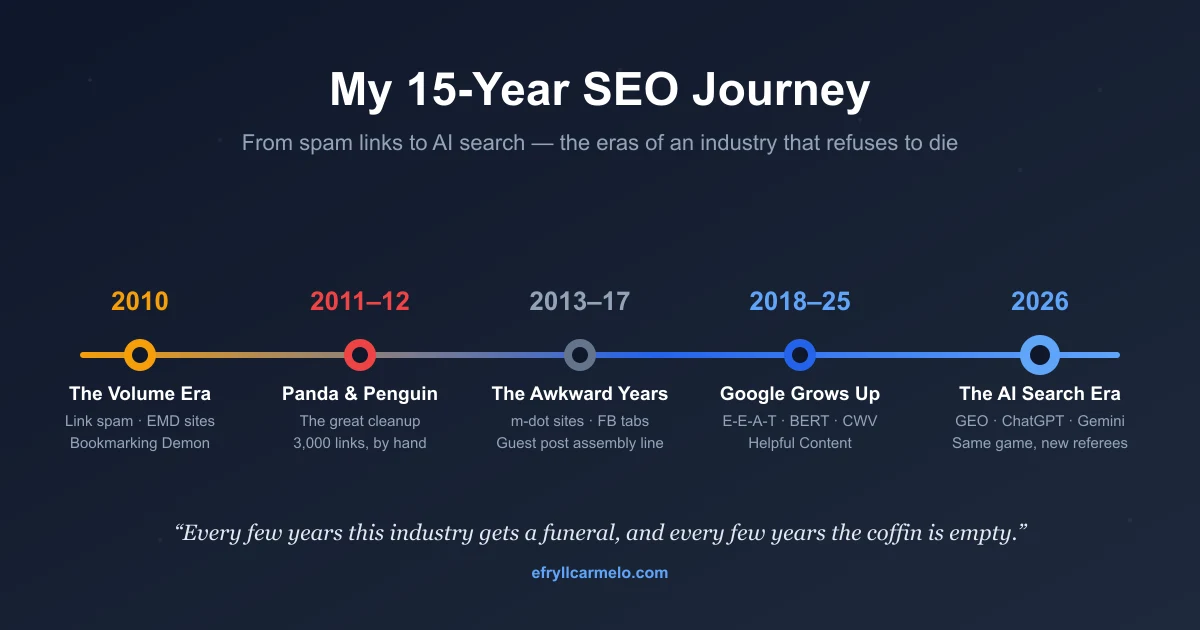
2010: The Volume Era, or How I Learned to Stop Worrying and Love the Spam
Here is what "doing SEO" meant when I started out in Iloilo City in 2010. This was the standard toolkit, and I used every single one of these:
- Bookmarking Demon: software that submitted your client's website to hundreds of social bookmarking directories overnight, while you slept. Automation before automation was cool.
- Market Samurai: the keyword tool of the era. You hunted for keywords nobody was competing for, then built a site around each one.
- The "Angela and Paul" backlink packets: a monthly subscription, like a magazine, except the magazine was a curated list of profile pages (including .edu and .gov domains) where anyone with ten minutes and a pulse could register an account and drop a link.
- Blogspot blogs: we wrote articles no human being would ever read, purely to hold links.
- EzineArticles: the same article, submitted in ten spun variations. "Spinning" was a job skill. It went on resumes.
- Yahoo Answers: we answered questions with the sincerity of a used-car salesman, always with a link back to the client.
None of it was meant for people. All of it was meant for a crawler. And the wild part? It worked.
I personally built around ten micro-niche websites on exact-match domains. Thin content, maybe fifteen pages each, slathered in Google ads. Each one earned $20 to $50 a month. That doesn't sound like much until you remember what $200–$500 a month in passive income meant to a fresh graduate in the Philippines in 2010. It felt like I had found a cheat code for the internet.
That era had a texture to it: hustling for clients on oDesk (before it became Upwork), Freelancer.com, and OnlineJobs.ph, competing with a thousand other Filipino freelancers for $2-an-hour link building gigs, and being genuinely thrilled to win them. It was the wild west, and we were all selling shovels made of spam.
2011–2012: Panda and Penguin Walk Into a Bar and Burn It Down
Then Google released a cute-sounding update named Panda (2011), followed by an even cuter one named Penguin (2012). If you weren't there, the names are misleading. It was less "adorable zoo animals" and more "asteroid impact with an extinction-level event for thin content and manipulative links." The full history of Google's updates reads calmly now. Living through it was anything but calm.
Overnight, everything we had built became a liability. And here's the detail younger SEOs never believe: Google's disavow tool didn't exist yet. It wouldn't arrive until late 2012. So when a client's site got hit, you couldn't just upload a file and tell Google to ignore the bad links. You had to remove them. By hand. Here's what that actually looked like:
- Export every backlink: one client site had 3,000 of them that needed to come down.
- Hunt down contact details for each webmaster, one by one.
- Politely email them, asking them to delete the very links we had spent years building.
- Discover that some wanted payment to remove them. Removal fees for our own spam! The audacity was almost admirable.
- Follow up. Follow up again. Document everything for the reconsideration request.
- Wait months, watching the client's revenue flatline, hoping Google would forgive you.
My micro-niche empire? Gone. The $20–$50 monthly checks dried up as those exact-match domains sank like stones. Entire agencies disappeared. It was the industry's first hard lesson, and I've never forgotten it: whatever shortcut works today is the cleanup job you'll be doing tomorrow. It's the exact reason that, all these years later, the first thing I do for any new client is a proper SEO audit, because I know from personal experience what's buried in an old backlink profile.
The Awkward Middle Years: m-dot Sites, Facebook Tabs, and the Guest Posting Hamster Wheel
People forget how strange the early 2010s web was. A few artifacts from that era that younger marketers refuse to believe existed:
- The m-dot site. Responsive design wasn't standard yet, so companies ran an entirely separate mobile version of their website at m.yourwebsite.com. Nothing to do with SEO, it was simply a second instance of the whole site that someone (usually me) had to build, update, and keep in sync with the desktop version by hand. Change a phone number on one, remember to change it on the other, forever.
- Facebook page tabs. Brands paid good money to design custom experiences inside Facebook itself, because for a moment everyone was convinced Facebook pages would replace websites entirely. (Narrator: they did not.)
- Guest posting, the assembly line years. After Penguin nuked link spam, the industry needed a new supply of links and found one. It started innocently: write a genuinely useful article for a relevant site, get a link, everyone wins. Within two years it was mass outreach templates, "write for us" pages charging $50 per post, and private blog networks dressed up as independent publications. We had, with impressive efficiency, reinvented the exact thing Penguin was built to kill, just with better grammar.
Google noticed. Google always notices, eventually. That's the pattern of this whole industry: a tactic works, the tactic scales, the tactic dies, and the people who survive are the ones who were also doing the unglamorous fundamentals: understanding what competitors actually rank for and why, keeping the technical house in order, and building pages that deserve to exist.
2018–2025: Google Grows Up (and Makes Us Grow Up Too)
The second half of the 2010s is when SEO stopped being a bag of tricks and became a profession. The rapid-fire version:
- 2018, the Medic update. Google started asking a very grown-up question: should this website be trusted on this topic? Expertise, authoritativeness, and trustworthiness went from rater-guideline jargon to rankings reality, especially for health and money topics.
- 2019, BERT. Google learned to actually read. Not match keywords, read. Conversational queries started returning results that understood intent, and keyword-stuffed pages started looking exactly as awkward as they always were.
- 2021, Core Web Vitals. Slow, janky pages officially became an SEO problem, and suddenly every SEO needed to be able to say "Largest Contentful Paint" with a straight face.
- 2022, the Helpful Content update. The clue is in the name. Content written for search engines instead of people, the entire spiritual descendant of my EzineArticles era, got systematically devalued. Building real topic-cluster content strategies and running honest content audits to prune the dead weight stopped being optional and became the job itself.
- 2023–2025, the enforcement years. Successive core and spam updates enforced Google's spam policies against content produced at scale without editorial oversight. Sites publishing thousands of unedited machine-written pages lost half their traffic or more. Panda all over again, just with a newer villain.
Fifteen years of watching this cycle gives you a certain calm. The tactics change. The lesson never does: Google's updates have never once punished genuinely useful content. Not one time. They punish shortcuts.
The local business owners I work on local SEO with are sometimes surprised that boring things like NAP consistency and a properly managed Google Business Profile beat every clever hack. But that's the whole story of 2010 to 2025 compressed into one sentence.
2026: The Machines Start Answering, and Everyone Schedules Another Funeral
Which brings us to now, and to the newest eulogy. The numbers driving it are real:
- AI Overviews now appear in roughly 25% of Google searches.
- Around 58.5% of U.S. searches end without a click to any website.
- ChatGPT has reached approximately 900 million weekly active users.
- AI-driven referral visits converted 31% better than traditional traffic during the 2025 holiday season.
The search box is turning into an answer box, and the answer box doesn't always feel like sending you traffic. Scary? Sure, a little. So was Panda. So was mobile. So was the day I realized 3,000 links had to come down by hand.
But here's what I see when I look at AI search: the same game with new referees. ChatGPT, Gemini, Perplexity, Grok, and Claude each pull from different indexes, weigh different signals, and cite different kinds of sources. Figuring out how each platform decides what to cite, the discipline now called Generative Engine Optimization, feels exactly like 2010 felt: new territory, unsettled rules, and enormous rewards for people willing to test things.
The difference is that this time the winning move isn't spam. It's being genuinely citable:
- Structured, specific, verifiable content: the kind optimized to be quoted, not just ranked.
- Platform-by-platform LLM strategy, because what gets you cited by Perplexity is not what gets you cited by Gemini.
- Honest measurement of where your AI traffic actually comes from, because you can't optimize what you don't track.
Different platform. Different challenges. Same job.
SEO Will Never Die (It Will Just Keep Changing Its Name)
Every few years this industry gets a funeral, and every few years the coffin is empty. Panda was supposed to kill SEO. Mobile was supposed to kill SEO. Voice search was supposed to kill SEO (remember when we all pretended to optimize for smart speakers?). Now AI answers are supposed to kill SEO.
What actually happens, every single time: the work gets renamed. Answer engine optimization. Generative engine optimization. AI SEO. Call it whatever the conference circuit likes this year. As long as there is a search box, there is an engine behind it, and there will be people whose job is to understand how that engine decides. That job has fed my family for fifteen years, through every apocalypse.
And if you're thinking about entering this field, this is the best possible moment. Three reasons:
- The starting line just reset. Nobody, and I mean nobody, has fifteen years of experience in AI search, because the field is barely a few years old. Veterans and newcomers are standing at the same starting line for the first time since I began.
- The barrier to entry has never been lower. In 2010 it was owning spam software. In 2026 it's curiosity.
- Everything is still being figured out. New platforms to reverse-engineer, new metrics to invent, new things to argue about on the internet. The fun is all around us.
Here is the truth nobody puts in the job description: this field never sits still, and that is the whole point. The rules change every year. The tools change every six months. Some mornings you wake up and a Google update has rearranged the board overnight. You do not survive fifteen years of that on tactics alone. You survive it on patience, because rankings are earned in months rather than days, and on a genuine love for the game, because the game refuses to stay the same.
That is what I signed up for in 2010 without knowing it, and it is why I am still here. I got to spend my first years in SEO spamming Yahoo Answers, and I will probably spend my next years teaching language models to cite my clients. The board keeps changing. The game stays worth playing. And I still cannot wait to see what it looks like next.
Frequently Asked Questions
Is SEO dead in 2026?
No. Search behavior is shifting to AI platforms like ChatGPT, Gemini, and Perplexity, but every platform still runs on an engine that retrieves and ranks content. The discipline is being renamed (GEO, AEO, LLM SEO), not retired. Demand for people who understand how these engines decide is growing, not shrinking.
Who is Efryll Carmelo?
Efryll Carmelo is a senior SEO manager based in Iloilo City, Philippines, working with US, Australian, and international clients since 2010. He is Google Partner certified, specializes in technical SEO, local SEO, and generative engine optimization, and has documented results including +80% revenue growth for a local services client and a 47% year-over-year organic traffic increase for an e-commerce client.
How do I get into SEO in 2026?
Start with the fundamentals that survived every algorithm update: how crawling and indexing work, what makes content genuinely useful, and how to measure results. Then experiment with AI search visibility, where veterans and newcomers are on the same starting line. Curiosity is the only entry requirement left.
Fifteen years of lessons, one client at a time.
If you want SEO strategy from someone who has personally survived every Google update since Panda, and cleaned up after most of them, let's talk. I offer a free 30-minute consultation.

Efryll Carmelo
Efryll Carmelo is a Senior SEO Manager based in Iloilo City, Philippines, with 15+ years of experience in SEO, content strategy, and AI search optimization. He's the sole author of this blog. You can connect with him on LinkedIn.