Most 'content strategies' are a spreadsheet of blog titles. Mine is an architecture. There is a difference, and both Google and the AI engines can tell which one they are looking at.
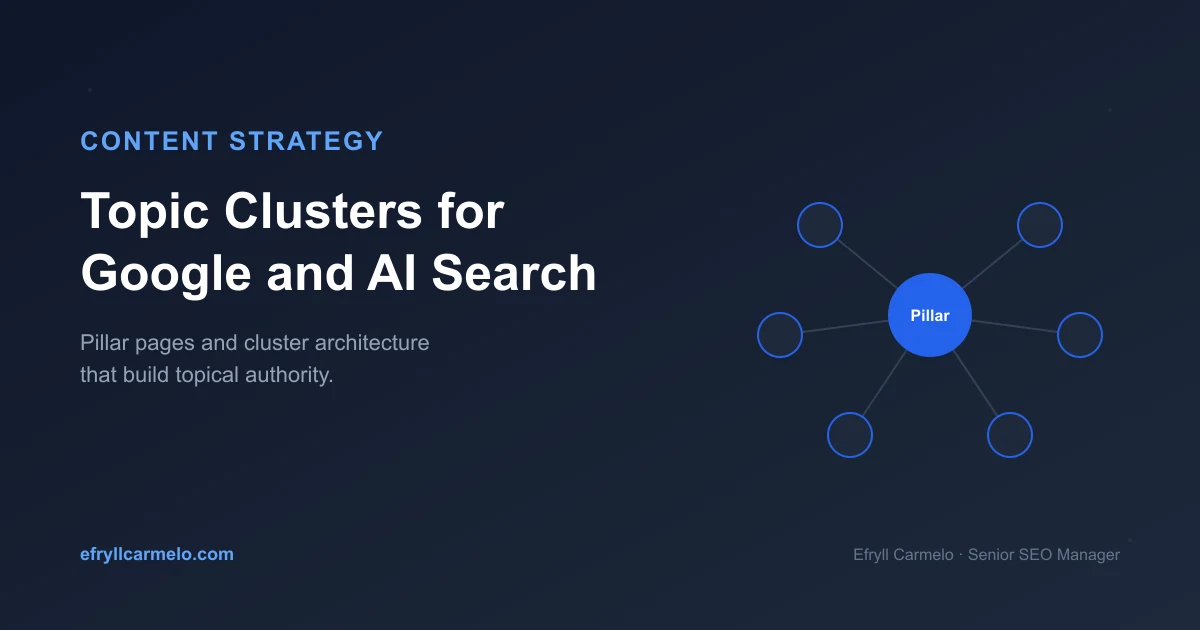
I build your content around topic cluster architecture: pillar pages supported by 8 to 12 cluster articles, each targeting an AI-decomposed sub-query. This structure drives your Google topical authority and maximizes your AI citation opportunities across ChatGPT, Gemini, and Perplexity at the same time.
Most 'content strategies' are a spreadsheet of blog titles. Mine is an architecture. There is a difference, and both Google and the AI engines can tell which one they are looking at.
I build every strategy around topic clusters, the highest-performing GEO content structure in the AI Search Ranking Strategy 2026 framework. Each cluster covers your topic comprehensively enough that AI platforms end up citing multiple pages from it for different aspects of what people ask.
Comprehensive topic overview (2,500–4,000 words). Covers the broad topic with enough depth to establish authority, links out to all cluster articles. Targets the head keyword.
Each cluster article targets one specific sub-query AI platforms decompose from the broader topic. Focused, 1,000–2,000 word articles that link back to the pillar page.
Each cluster article is mapped to a specific sub-query an AI platform uses when decomposing the pillar topic. This ensures citation opportunities across the full range of related user questions.
Topic clusters are the most misused term in content. Most versions are a keyword list wearing a trench coat. Here is what the real thing looks like when I build one as a senior SEO manager and specialist.
After 15 years of inheriting other people's content strategies, the failure patterns are depressingly consistent. The strategy is a spreadsheet of blog titles with no architecture. Nobody owns distribution, so publishing is treated as the finish line. Success is measured in pageviews, which makes thin viral-adjacent content look better than the bottom-of-funnel piece that quietly closes deals.
The fix is structural, not motivational: clusters with jobs, optimization built into the template rather than bolted on later, and measurement tied to leads instead of traffic. When those three are in place, content stops being a cost center you have to defend every quarter.
The architecture in one view. Every piece has a role, a count, and a linking rule.
| Element | Role | Rules |
|---|---|---|
| Pillar page | Comprehensive topic overview targeting the head term | One per topic; links down to every cluster |
| Cluster articles | Each answers one sub-query in depth | 8 to 12 per topic; link up to the pillar |
| Internal links | Concentrate authority on the pillar | Descriptive anchors, no orphans |
| Refresh cycle | Keep the set current | Review dates assigned at publish |
A pillar page (comprehensive broad topic) supported by 8–12 cluster articles (specific sub-topics), all linking back to the pillar. Concentrates topical authority for Google rankings while maximizing AI citation opportunities by covering multiple sub-queries an AI would decompose from the pillar topic.
AI platforms decompose queries into sub-queries. A topic cluster covering multiple sub-queries with dedicated pages maximizes citation opportunities across an entire topic area. Topic cluster architecture is the highest-performing GEO content structure per the AI Search Ranking Strategy 2026 framework.
Topic cluster map, keyword-to-page mapping, content priority ranking, content brief templates per cluster article (with BLUF requirements, Answer Capsule specs, FAQ questions, schema type, internal link targets), and a 6-month content calendar.
8–12 cluster articles per pillar is the optimal range per the AI Search Ranking Strategy 2026 framework. Fewer than 8 leaves AI sub-query coverage gaps. More than 12 often requires overlap in sub-query targeting, reducing per-article focus.
A structured document guiding content creation. For GEO-optimized content: primary and secondary keywords, word count, BLUF requirements, Answer Capsule specification (40–60 words), FAQ questions (matching AI query patterns), required statistics, schema type, and internal link targets.
Individual cluster articles targeting long-tail sub-queries often rank within weeks. The pillar page targeting the competitive head term typically takes 3 to 6 months, because it needs the accumulated authority of the whole cluster plus external signals. The cluster structure is what shortens both timelines.
Fewer than you think. Two or three genuinely deep clusters on topics tied to revenue beat ten shallow ones. Start with the topic closest to your highest-value service, prove the model, then expand. Topical authority is depth-first, not breadth-first.
Topic clusters built for AI sub-query coverage: ranking on Google while earning citations in ChatGPT, Gemini, and Perplexity. Book a free content strategy session.
Book a Free Consultation →