TL;DR
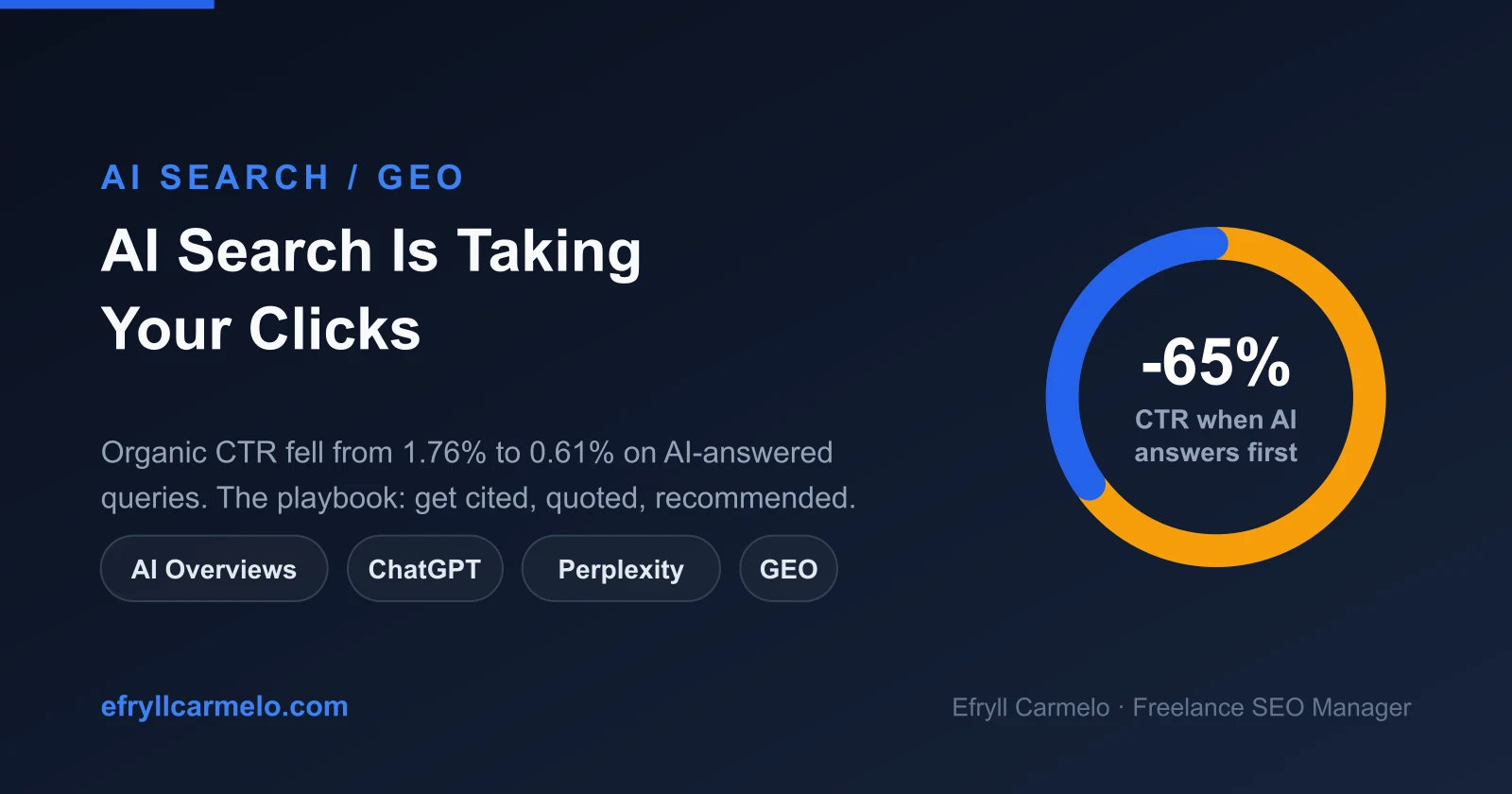
- When an AI Overview appears, organic click-through rates collapse: Seer Interactive measured a drop from 1.76% to 0.61%, and Pew found users click a traditional result in only 8% of AI-answered searches.
- The counter-move is GEO: generative engine optimization. Stop competing only for positions in a list; compete for citations inside the answer.
- Brands cited in AI answers earn dramatically more clicks than uncited brands. The scoreboard changed; the game did not end.
- The playbook: answer-shaped content, schema, AI crawler access, third-party trust signals, and monthly citation tracking.
In 2010 the question clients asked me was "why aren't we ranking?" In 2026 it is "we ARE ranking, so where did the clicks go?" Both questions have honest answers. The second one just has a scarier chart.
I have been doing GEO work since before it had that acronym, partly because being a freelance SEO manager in the Philippines serving US and UK clients means I cannot afford to be late to anything. Here is what the shift actually looks like in the data, and what a quarter of AI search work contains when I run it for a client.
The Numbers, Without the Doom Filter
Three findings define the 2026 situation. Seer Interactive's analysis, covered by Search Engine Land, found that on queries showing an AI Overview, average organic CTR fell from 1.76% to 0.61%. Pew Research, in a separate study, found users clicked a traditional result in just 8% of searches with an AI summary versus 15% without.
Now the part the doom posts skip: the same Seer research found that brands cited INSIDE the AI Overview earned roughly 35% more organic clicks than uncited brands. The clicks did not vanish uniformly. They consolidated onto the sources the AI trusts. That is not the death of search visibility; it is a redistribution toward a smaller number of winners, and your job is to be one of them.
Old Scoreboard, New Scoreboard
| Traditional SEO | GEO (generative engine optimization) | |
|---|---|---|
| Compete for | Ranked positions in a list of links | Citations and mentions inside generated answers |
| Won by | Relevance, authority, technical health | All of that, plus quotable structure, specific claims, entity consistency |
| Measured in | Rankings, clicks, conversions | Citation frequency, share of voice across engines, AI referral traffic |
| Content that wins | Comprehensive pages targeting keywords | Direct answers to real questions, with data and expert opinion worth quoting |
| Failure mode | Ranking on page 2 | Being invisible in answers your buyers read |
The overlap between columns is deliberate: GEO stands on SEO. AI engines cite sources that already demonstrate authority the old-fashioned way. Search Engine Land's GEO explainer makes the same point: this is an extension of the discipline, not a replacement.
What a Quarter of GEO Work Actually Contains
Theory is abundant; here is practice. When I run AI search work for a client, a quarter contains five workstreams:
- Citation baseline. I run the client's 20 to 40 money queries through ChatGPT, Perplexity, Gemini, and Google's AI Overviews, and log who gets cited. This becomes the scoreboard we report against monthly. It is sobering the first time; most brands discover a competitor or a random affiliate site owns their category's answers.
- Answer-shaped content. Existing pages get restructured so a machine can lift the answer cleanly: a direct answer capsule up top, question-formatted H2s, specific claims with numbers, tables. Search Engine Journal's roundup of GEO strategies for 2026 matches what I see empirically: structured, claim-dense, Q&A-shaped pages get cited more.
- Technical access. robots.txt must welcome GPTBot, OAI-SearchBot, ClaudeBot, PerplexityBot, and Google-Extended; schema must be airtight; llms.txt gets added. I practice this on my own site, which is how I know the deployment details by heart. The full stack is described on my LLM SEO services page.
- Third-party trust. AI engines lean heavily on listicles, review platforms, and industry roundups when recommending vendors. Getting my clients onto the specific third-party pages the engines already cite is the new link building, and it is the highest-leverage move on this list.
- Measurement. AI referral traffic in GA4, citation tracking, and share-of-voice trends go into the monthly report next to the traditional numbers.
Where the Clicks Still Live
Strategy note that saves budgets: the CTR collapse is concentrated in informational queries, the "what is / how does" layer. Transactional, comparison, and local queries still deliver clicks, because buyers still need to reach a website to actually buy, compare, or book. So the 2026 allocation I run for clients defends and expands the transactional layer with classic SEO while building citation presence on the informational layer with GEO. Publishing generic top-of-funnel explainers and expecting traffic is the one strategy that is genuinely dead.
What to Do This Quarter
If you do nothing else: run your ten most valuable queries through ChatGPT and Perplexity today and see who owns your answers. If it is not you, that gap is compounding monthly as AI engines reinforce their source preferences. My GEO services and AI SEO pages describe the full engagement, and my earlier posts on what a freelance SEO specialist does all week show where this work fits in a normal retainer.
Or shortcut the diagnosis: book a free 30-minute consultation and I will run your top queries through the engines live on the call. Five minutes of watching who gets cited for your category is usually all the convincing anyone needs.
Frequently Asked Questions
What is GEO (generative engine optimization)?
Generative engine optimization is the practice of making your brand the source that AI systems cite, quote, and recommend when they answer user questions. Where traditional SEO competes for ranked positions in a list of links, GEO competes for presence inside the generated answer itself, across Google AI Overviews, ChatGPT, Perplexity, Gemini, and Copilot. The tactics overlap with SEO but add citation tracking, answer-shaped content, aggressive structured data, and AI crawler access.
How much traffic do AI Overviews take from websites?
Multiple 2025 studies measured severe click-through declines when an AI Overview appears: Seer Interactive found organic CTR on affected queries fell from 1.76 percent to 0.61 percent, and Pew Research found users clicked a traditional result in only 8 percent of searches with an AI summary versus 15 percent without one. The decline is real but uneven: transactional and local queries still drive clicks, and brands cited inside AI answers earn significantly more clicks than uncited brands.
How do I get my brand cited by ChatGPT and Google AI Overviews?
Five moves matter most: publish content structured as direct answers to real questions, with clear headings and specific claims backed by data; implement Article, FAQ, Organization, and Breadcrumb schema; allow AI crawlers like GPTBot, ClaudeBot, and PerplexityBot in robots.txt; earn presence on the third-party listicles and review sites AI engines already trust for your category; and keep entity information consistent everywhere your brand appears. Then test your money queries in each engine monthly and track citations.
Is traditional SEO dead now that AI answers questions?
No. AI engines learn from and cite content that ranks and earns authority, so traditional SEO is the foundation GEO stands on. What has died is the strategy of publishing generic informational content and expecting clicks, because AI absorbs those queries. The working 2026 strategy defends transactional and comparison queries, builds content AI wants to cite, and measures visibility in answers alongside visits.

Efryll Carmelo
Efryll Carmelo is a Senior SEO Manager and freelance SEO specialist based in Iloilo City, Philippines, with 15+ years of experience in SEO, content strategy, and AI search optimization for clients in the US, Canada, UK, and Australia. He's the sole author of this blog. You can connect with him on LinkedIn.