TL;DR
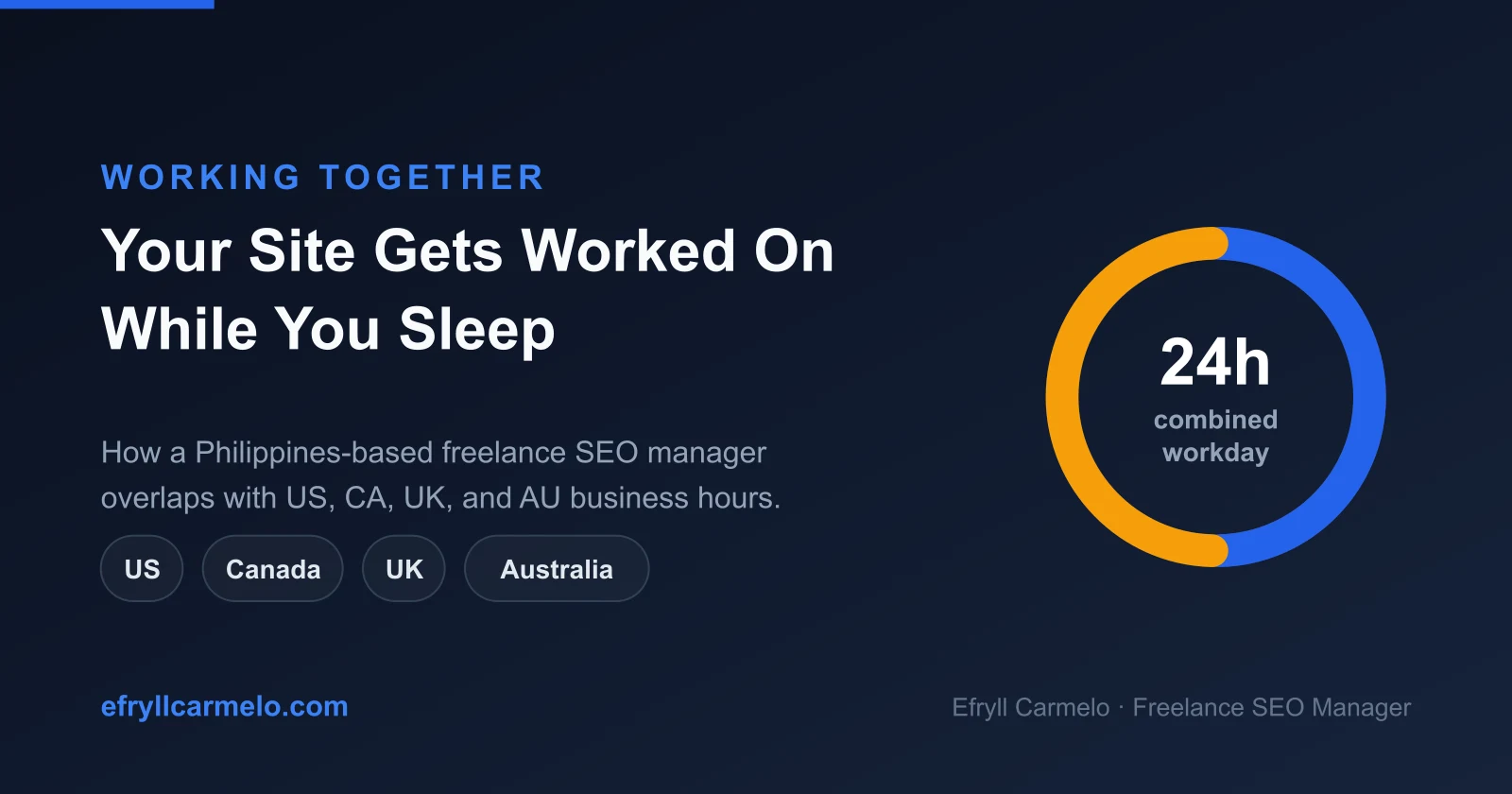
- Manila overlaps Australia almost completely (2-hour difference), the UK naturally (my evening = London morning), and the US by arrangement (my night shift = your business day).
- SEO is 90% asynchronous deep work. The offset means your site gets worked on while you sleep, and the results are in your inbox at breakfast.
- The 10% that needs synchronization gets solved with four onboarding agreements: standing meeting slots, response-time commitments, an escalation channel, and a weekly written report.
- My longest client relationship ran six years across a 12-hour gap. Distance was never the thing that ended any engagement I have seen; silence was.
Somewhere in the first call, every international prospect asks it, usually apologetically: "How does the time difference work?" It is a fair question with a boring answer, and the boring answer is the point: after 15 years of serving US, Canadian, UK, and Australian clients from the Philippines, the timezone has never been the reason an engagement succeeded or failed.
The Actual Overlap Windows
| Your market | Offset from Manila | Natural overlap | How meetings actually happen |
|---|---|---|---|
| Australia (AEST) | +2 hours | Nearly the full workday | Any time; this is effectively same-timezone work |
| United Kingdom | -7 / -8 hours | My 4 to 8 p.m. = London 9 a.m. to noon | Standing morning-UK slots, no schedule bending needed |
| US East / Canada East | -12 hours | Mirror image | My 9 to 11 p.m. = your 9 to 11 a.m.; I hold evening windows |
| US West / Canada West | -15 / -16 hours | My early morning = your afternoon | My 6 to 8 a.m. = your 2 to 4 p.m. previous day |
Notice Australia barely belongs in this article: Sydney and Manila share a workday, which is one reason Australian companies have been hiring Philippine talent for two decades. And the US "mirror image" is less awkward than it looks, because of an inheritance the Philippines gets from its outsourcing industry: night-shift culture is normal here. Working 9 p.m. to midnight to cover a US morning is not heroic; it is Tuesday. I covered why that industry history matters in why Western companies hire Philippine SEO specialists.
Why SEO Is the Best-Case Remote Discipline
Here is the part the timezone worry misses: almost nothing in SEO requires two people awake simultaneously. Look at the week I documented in what a freelance SEO specialist actually does: crawls, audits, content briefs, on-page optimization, developer tickets, analysis, reporting. All of it is deep work best done without meetings, whatever timezone it happens in.
The offset then flips into an advantage. You email a request at 5 p.m. New York; it is 5 a.m. in Manila, the start of my day. By your next morning, the work is done and documented. Your business effectively runs a longer day: US hours for your team, Manila hours for your SEO. One of my American clients called this "the elves arrangement," and I have never found a better description. The shoemaker sleeps; the shoes get made.
The System That Makes It Boring
Async-first collapses without discipline, so every engagement starts with four written agreements:
- Standing meeting slots in YOUR timezone. Weekly or biweekly, booked at onboarding, never renegotiated ad hoc. Predictability beats availability.
- Response-time commitment. Normal messages answered within one business day, defined in your calendar, not mine.
- An escalation channel. A genuine emergency (site down, traffic cliff, manual action) gets a faster path. In 15 years the channel has been used rarely, but its existence is what lets clients relax.
- The weekly written note. What changed, what moved, what is next, readable in ninety seconds. Written reporting matters double across time zones because it removes the need for status meetings entirely. The standard I hold these to is described in Search Engine Land's SEO reporting guide, and my own system is on the analytics and reporting page.
That fourth item is the load-bearing one. Search Engine Journal's advice on succeeding as an SEO freelancer puts communication at the center of freelance survival, and distance simply raises the stakes: an onshore freelancer who goes quiet for a week is annoying, while an offshore one triggers every fear the client had at signing. So I over-communicate in writing, deliberately, and always have.
The Real Risk Is Not the Clock
Let me name the fear under the question, because it deserves a direct answer. The worry is not really about hours; it is "if something goes wrong, will someone far away care at 2 a.m.?" Fair. The honest response is that caring is a property of the person, not the geography, and you test for it the same way everywhere: engagement length. Ask any candidate how long their clients stay. My answer is that my longest relationship ran six years across a 12-hour gap, and the client's explanation was one sentence: "you never disappeared on us." Distance does not end engagements. Silence does, and silence happens in the same city all the time.
If you want senior SEO without adding a salary in your own timezone, the arrangement is more battle-tested than you think; my fractional SEO manager service is built on it, run by a freelance SEO manager in the Philippines who has kept international clients for years at a stretch. Book a call; I will take it in your timezone, which is rather the point.
A Real Day, Hour by Hour
Abstractions about "overlap windows" are less useful than seeing the shape of an actual day. This is my normal weekday when I am carrying US East Coast clients, in Manila time:
| Manila time | US Eastern | What is happening |
|---|---|---|
| 6:00 to 9:00 a.m. | 6:00 to 9:00 p.m. (previous day) | Deep work block. Crawls, audits, content briefs, technical analysis. Nobody is awake to interrupt me, which is exactly why this is the most productive stretch of my day. |
| 9:00 a.m. to 12:00 p.m. | 9:00 p.m. to midnight | Implementation. On-page changes, schema, developer tickets written and queued for your morning. |
| 1:00 to 5:00 p.m. | 1:00 to 5:00 a.m. | Reporting, dashboards, competitor monitoring, and admin. Also the block I use for AU and UK client calls. |
| 8:00 to 11:00 p.m. | 8:00 to 11:00 a.m. | The live window. Client calls, Slack back-and-forth, anything needing a real conversation. Your morning, my evening. |
The important thing in that table is not the hours. It is that the live window is deliberate and repeating, not something I improvise when someone pings me. You know when you can reach me in real time, and everything outside that window is async by design rather than by accident.
The Daylight Saving Trap Nobody Warns You About
Here is the detail that catches out almost every new international engagement, and I have never seen it mentioned in a hiring guide: the Philippines does not observe daylight saving time. We sit at UTC+8 all year, every year.
Your country almost certainly does shift. Which means the gap between us is not a fixed number, and any standing meeting booked in the wrong direction quietly breaks twice a year:
| Market | Their winter gap | Their summer gap | What shifts |
|---|---|---|---|
| US Eastern | 13 hours | 12 hours | Clocks move in March and November |
| US Pacific | 16 hours | 15 hours | Same March and November dates |
| United Kingdom | 8 hours | 7 hours | Clocks move late March and late October |
| Sydney and Melbourne | 2 hours ahead | 3 hours ahead | Opposite calendar: shifts in October and April |
| Brisbane and Perth | 2 hours / same | 2 hours / same | No daylight saving at all, so these never move |
The fix is trivial once you know about it, and painful if you do not. Book every recurring meeting in the client's time zone, never in mine. If the calendar invite is anchored to New York, it follows New York through the switch automatically and I absorb the change on my end. If it is anchored to Manila, then twice a year your 9 a.m. call silently becomes an 8 a.m. call and somebody misses it.
Australia is worth calling out separately, because its daylight saving runs on the opposite calendar to the northern hemisphere. Sydney drifts from two hours ahead of me to three hours ahead in October, right when the US and UK are moving the other way. It is a small thing that makes me look either organized or careless, so I track it.
Holidays: The Other Calendar Problem
Time zones get all the attention while holidays cause more actual disruption, because they remove whole days rather than shifting a few hours.
The Philippines has a lot of public holidays, and a few are genuinely immovable: Holy Week in March or April, when the country effectively stops for several days, plus Christmas and New Year, and Independence Day in June. Some are declared with only a few weeks of notice, which is a quirk foreign clients find surprising.
Meanwhile your calendar has days I do not observe at all: Thanksgiving, Independence Day in July, Memorial Day, the UK bank holidays, Australia Day, Boxing Day.
The way I handle this is unremarkable and works: I send clients my holiday list at the start of each year, I flag any newly declared holiday as soon as it is announced, and I front-load work before Holy Week rather than pretending the week will be normal. In return I keep working through your holidays unless we agree otherwise, which is often useful. Several clients have found that the week between Christmas and New Year is the best week of the year for shipping technical fixes, precisely because their own team is away and nothing else is changing on the site.
The Async Toolkit, and How Each Piece Is Actually Used
Async-first is a discipline, not a tool purchase, but the tools do matter because they decide how much context survives the twelve-hour gap. What I use, and more importantly what each one is for:
Slack or Teams
Day-to-day contact, with threads rather than DMs so context is searchable later. I write updates as if the reader is catching up eight hours behind, because they usually are.
Loom or screen recordings
The highest-value async tool by some distance. A four-minute walkthrough of an audit finding replaces a thirty-minute call that would have required both of us awake. You watch it at breakfast and reply in writing.
Asana, Jira, Trello, or ClickUp
Tickets with enough detail that your developer never has to wait for me to clarify. A vague ticket across a twelve-hour gap costs a full day; a complete one costs nothing.
A live Looker Studio dashboard
So you never have to ask me for a number. Open it whenever you want, at any hour, without waiting for my working day to start.
The pattern across all four is the same: each one removes a reason to need me awake. That is the whole design goal. A remote engagement fails when the client is repeatedly blocked waiting for a reply, and every tool above exists to make that less likely.
What Actually Happens When Something Breaks at 2 a.m.
The escalation channel is easy to promise and worth describing concretely, because "we have an escalation path" means nothing until you know what it looks like.
A genuine emergency is a short list: the site is down or serving errors, organic traffic falls off a cliff, a manual action appears in Search Console, or a deployment has broken indexing or redirects. Not a ranking dropping two positions. Not a competitor outranking you this week.
- You have a channel that reaches my phone, separate from normal Slack. It is agreed at onboarding and it bypasses the response-time rules entirely.
- I acknowledge before I diagnose. Even at 3 a.m. my time, the first message back is confirmation that I have seen it and am looking, because the worst part of an incident at a distance is not knowing whether anyone is awake.
- I diagnose and report in writing, including what I can fix myself and what needs your developer. If it needs someone with production access, you have a written brief waiting rather than a conversation to schedule.
- A short write-up afterwards covering what happened, what fixed it, and what stops it recurring. Across fifteen years, the recurrence prevention step is the one that has mattered most.
In practice the channel gets used rarely. Its value is not the frequency of use. It is that you stop worrying about the scenario, which is what the time zone question was really about from the beginning.
Frequently Asked Questions
Can a freelance SEO manager in the Philippines work US business hours?
Yes. The Philippine professional class has two decades of night-shift culture from the outsourcing industry, and many senior SEOs, myself included, routinely hold meetings in US morning or afternoon windows. Manila is 12 hours ahead of US Eastern time, so a 9 a.m. New York meeting is 9 p.m. in Manila, a comfortable evening slot. Agree on standing meeting windows during onboarding and the time difference stops being a factor.
How does the time difference affect SEO work quality?
For the work itself, not at all, and often positively. SEO is mostly deep asynchronous work: audits, content, analysis, and implementation do not require anyone else to be awake. The offset means work happens during the client's night and results are waiting in the morning, effectively giving the business a longer working day. The only part that needs synchronization is meetings and urgent escalations, both solvable with agreed windows and response-time commitments.
Which time zones does the Philippines overlap with best?
Australia is the easiest: Sydney is only 2 hours ahead of Manila, giving a full shared workday. The UK has a natural overlap in Manila's late afternoon and evening, which is London's morning. US and Canadian time zones are the largest offset at 12 to 16 hours, handled either by the freelancer working evening hours to match US mornings, or by an async-first arrangement with scheduled calls twice a week.
What should I agree on with an offshore SEO freelancer about communication?
Four things, in writing, during onboarding: standing meeting slots in your timezone, a maximum response time for normal messages such as within one business day, an escalation channel for genuine emergencies with a faster commitment, and a weekly written report that makes progress visible without requiring a call. Engagements with these four agreements almost never develop communication problems; engagements without them usually do.
Does daylight saving time affect working with a Philippines-based SEO manager?
Yes, and it catches out most new engagements. The Philippines does not observe daylight saving and stays at UTC+8 all year, while the US, UK, and most of Australia shift their clocks. The gap therefore changes twice a year: US Eastern moves between 12 and 13 hours, the UK between 7 and 8 hours, and Sydney between 2 and 3 hours ahead. The fix is to book every recurring meeting in your time zone rather than mine, so the invitation follows your clock change automatically and the freelancer absorbs the shift.
How do Philippine public holidays affect an SEO engagement?
Holidays disrupt more than time zones do, because they remove whole days rather than shifting a few hours. The Philippines observes Holy Week in March or April, Christmas and New Year, and several national holidays, some of which are declared at short notice. The workable approach is for the freelancer to send a holiday calendar at the start of the year, flag newly declared dates as they are announced, and front-load work before Holy Week. In exchange, many offshore freelancers keep working through US and UK holidays, which is useful for shipping technical fixes while your own team is away.
What happens if my site breaks outside your working hours?
You get an escalation channel agreed at onboarding that reaches me directly and bypasses the normal response-time rules. It covers genuine emergencies: the site down or serving errors, organic traffic falling off a cliff, a manual action appearing in Search Console, or a deployment breaking indexing or redirects. My first message back is an acknowledgment before diagnosis, because the hardest part of an incident at a distance is not knowing whether anyone is awake. Diagnosis and fixes are reported in writing, followed by a short write-up covering what prevents a recurrence.

Efryll Carmelo
Efryll Carmelo is a Senior SEO Manager and freelance SEO specialist based in Iloilo City, Philippines, with 15+ years of experience in SEO, content strategy, and AI search optimization for clients in the US, Canada, UK, and Australia. He's the sole author of this blog. You can connect with him on LinkedIn.