TL;DR
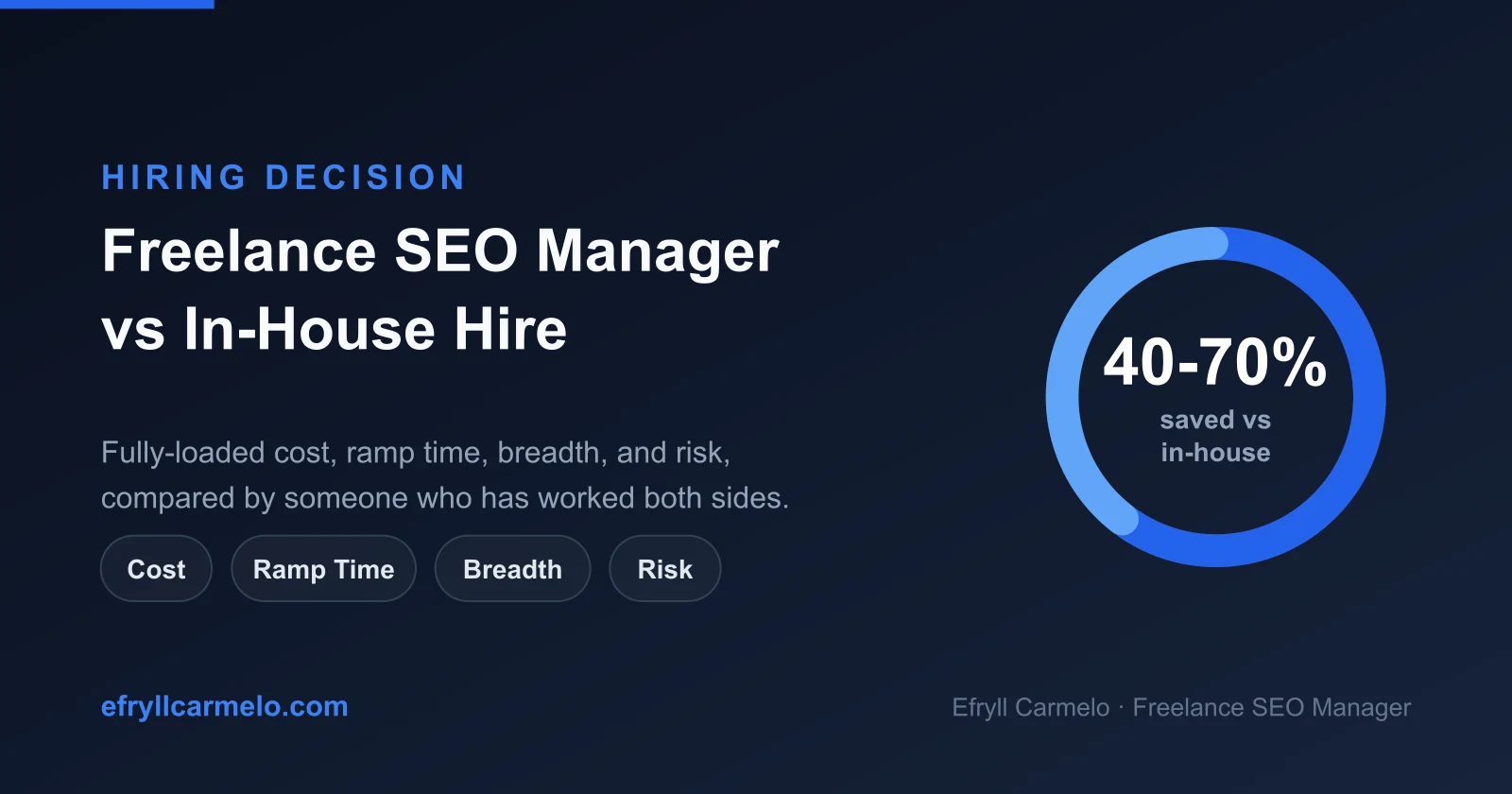
- Fully loaded, a senior US in-house SEO manager costs $115,000 to $200,000 a year. A senior freelance SEO manager on retainer runs $30,000 to $96,000, with zero recruiting, benefits, or severance overhead.
- In-house wins on presence and single-company focus. Freelance wins on seniority per dollar, ramp speed, and breadth from seeing many sites.
- The trap in the middle: hiring one junior in-house generalist and expecting senior outcomes.
- The hybrid most SMBs actually need: senior freelancer directs strategy, internal person owns content and coordination.
I am an unusual referee for this match, because I have played every position: freelance manager running client SEO from the outside, embedded specialist working inside in-house marketing teams, and team lead training juniors. Each model has a real case. Most articles about this are written by whoever is selling one of them; consider this the version with the incentives disclosed and the trade-offs left in.
The Comparison, Straight
| In-house SEO manager | Freelance SEO manager | |
|---|---|---|
| Fully-loaded annual cost (US) | $115,000 to $200,000 (salary + 25 to 40% overhead) | $30,000 to $96,000 retainer, scope-dependent |
| Ramp time | 2 to 4 months recruiting + onboarding | Working within 1 to 2 weeks |
| Experience breadth | Deep on your site, narrow across sites | Pattern library from dozens of sites and niches |
| Availability | 40 hours, your hours, your meetings | Scoped hours; response times by agreement |
| Continuity risk | Resignation restarts a 3-month cycle | Engagement can end fast too, but documented handoff is the norm |
| Best when | SEO is core, permanent, and genuinely full-time | You need senior outcomes on an SMB budget |
The Cost Math Everyone Underestimates
Salary surveys tell only half the story. Search Engine Journal's look at the SEO career landscape shows how experience concentrates at the top of the pay scale, and that is before the invisible line items: payroll taxes, benefits, recruiting fees (often 15 to 20% of first-year salary), tool licenses, management time, and the risk-cost of a mis-hire, which in SEO takes six months to even detect because the channel moves slowly.
The freelance line has its own fine print, to be fair: a good freelancer's retainer looks expensive per hour precisely because you are not paying for the idle hours. You buy the work, not the seat. My rates breakdown in how much a freelance SEO manager costs in 2026 shows the bands; the short version is that the freelance column above buys 10 to 15 years of experience, while the same money in-house buys 1 to 3.
What In-House Genuinely Does Better
Honesty section, since I sell the other column. An employee is in the room: they absorb product knowledge by osmosis, catch the redesign plan before it ships with noindexed templates, and build relationships with the dev team that make tickets move. They think about one business all day. If your organic channel is large enough that its problems are full-time problems, that presence compounds, and you should hire it. The freelancer's counter is breadth: because I work across niches, I have usually seen your exact problem before, on someone else's site, with the fix already tested. In-house depth versus cross-site pattern recognition is the real trade, not cost.
The Trap: The Junior Generalist In Between
The worst outcome I see repeatedly: a company budgets $60,000, hires one junior in-house "SEO and content person," and expects senior results. Eighteen months later there is a blog nobody reads, a stack of unfixed technical issues, and a conclusion that "SEO doesn't work for us." It was never going to work; the role needed either senior judgment or clear senior direction, and it had neither. Search Engine Journal's freelance survey data explains the supply side: experienced SEOs increasingly prefer freelancing's economics, so the senior in-house candidate pool at SMB salaries is thin to nonexistent.
The Hybrid That Usually Wins
For most small and mid-size companies, the right structure is not either/or. It is a senior freelance SEO manager in the Philippines owning strategy, audits, technical direction, and measurement, paired with an internal owner (often a marketing generalist) handling content production and internal coordination. The freelancer's judgment directs the internal person's hours. This is exactly the model behind my fractional SEO manager service, and it produced my favorite proof point: a local-services client on a brand-new domain that grew revenue 80%, with me directing and their small team executing. I compared this setup against agencies and full-time hires in detail in fractional vs agency vs full-time.
The hybrid also solves the exit: when the company outgrows it, the freelancer helps hire and train the in-house team, then steps back to advisory. I have done that handoff. It is the healthiest way an engagement ends.
A Decision Rule You Can Use Today
- List the SEO work you actually need monthly: strategy, technical, content, links, AI search, reporting. My post on what a freelance SEO specialist does all week is a usable checklist.
- If it honestly sums to 40 hours a week excluding content writing AND you can attract senior talent: hire in-house.
- If it sums to less, or your budget caps below $100k fully loaded: senior freelancer, possibly with an internal content owner.
- Whichever you pick, judge candidates with the same rigor; my 12 interview questions work for both columns.
Still genuinely torn? That conversation is free: book a 30-minute consultation and I will tell you honestly which column your situation belongs in, including "hire in-house, and here is the job description," if that is the truth.
If the hybrid is where you land, that is exactly the arrangement I describe on my remote SEO manager page: a senior owner directing strategy while your internal people execute.
Frequently Asked Questions
Is it better to hire a freelance SEO manager or an in-house SEO?
It depends on scale and maturity. An in-house hire makes sense when SEO is a core, permanent growth channel with enough work for 40 hours a week, typically at larger companies. A freelance SEO manager wins for small and mid-size companies because you get senior experience for a fraction of a senior salary, no benefits overhead, and immediate ramp. The most common right answer is a hybrid: a senior freelancer who directs strategy while an internal person owns content and coordination.
How much cheaper is a freelancer than an in-house SEO manager?
A senior in-house SEO manager in the US costs roughly $90,000 to $150,000 in salary, plus 25 to 40 percent in benefits, taxes, tools, and overhead, so $115,000 to $200,000 fully loaded. A senior freelance SEO manager on retainer runs $30,000 to $96,000 a year depending on scope and market, with no benefits, no recruiting fees, and no severance risk. For most SMBs the freelancer delivers comparable seniority at 40 to 70 percent less total cost.
What are the downsides of a freelance SEO manager vs an employee?
Four honest ones: divided attention if the freelancer carries many clients, less physical presence in company culture and meetings, dependency on one external person who could leave, and less hour-by-hour availability than someone on payroll. Mitigations exist for each: choose freelancers with small client rosters, set a fixed meeting rhythm, require documented processes so knowledge transfers, and agree on response-time expectations upfront.
When should a company move SEO in-house?
Move in-house when three conditions hold: organic search drives a large, provable share of revenue; there is genuinely 40 hours a week of SEO work excluding content writing; and you can attract senior talent, which is hard because experienced SEOs often prefer freelancing or agency variety. Many companies bridge with a freelance or fractional SEO manager who later helps hire and train their in-house replacement.

Efryll Carmelo
Efryll Carmelo is a Senior SEO Manager and freelance SEO specialist based in Iloilo City, Philippines, with 15+ years of experience in SEO, content strategy, and AI search optimization for clients in the US, Canada, UK, and Australia. He's the sole author of this blog. You can connect with him on LinkedIn.