TL;DR
- Multi-location local SEO is not single-location SEO times N: every location fights its own proximity battle with its own signals.
- The four pillars per location: a location page that earns its existence, an actively managed Google Business Profile, review velocity, and local links.
- The most common failure: copy-pasted location pages with the city name swapped. Google notices; so do customers.
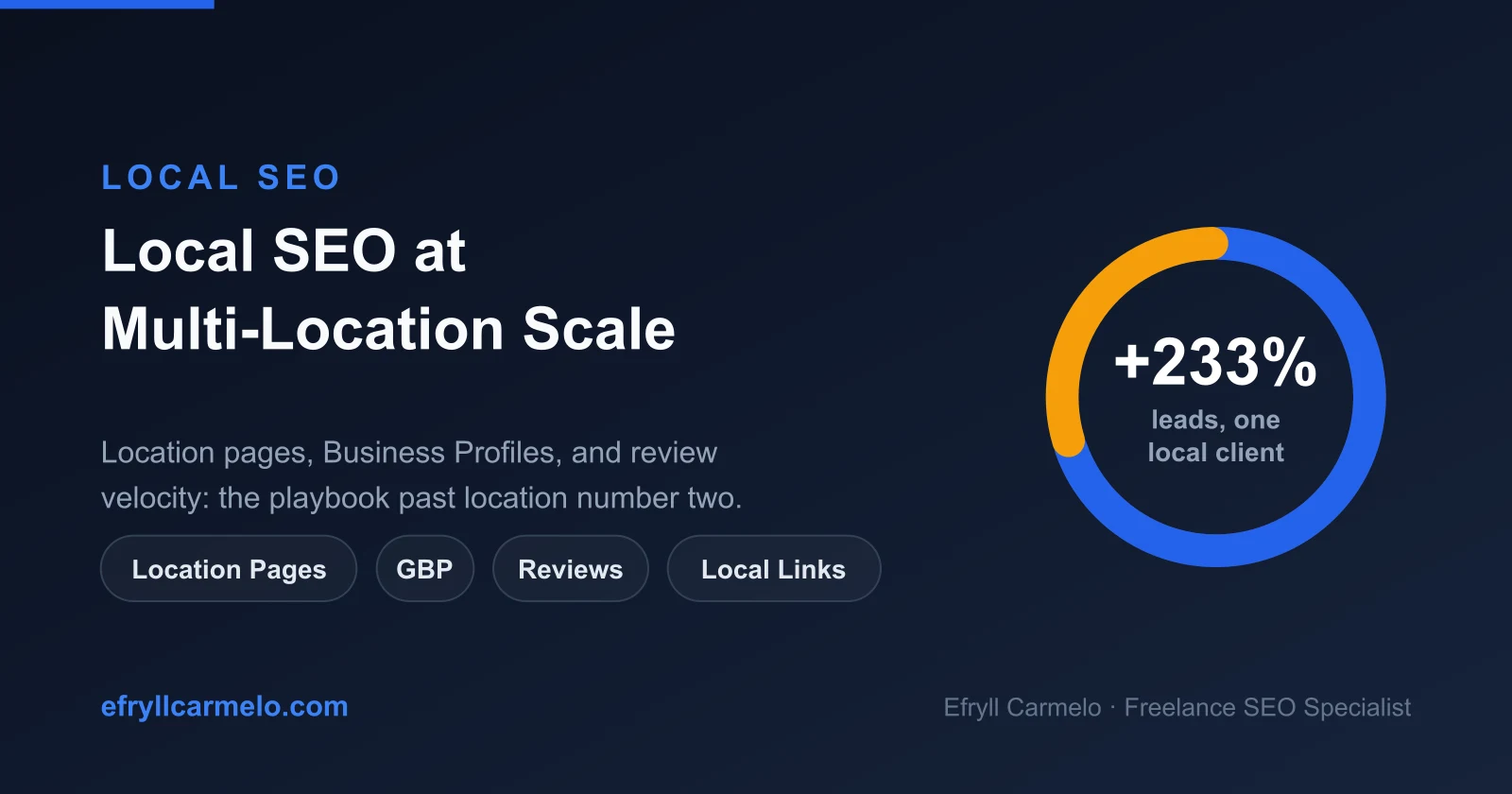
- Proof this compounds: +233% leads and 75% vacancy reduction for my assisted living client, and +80% revenue for a local-services client on a brand-new domain.
The multi-location story always starts the same way. One location, some solid local SEO effort, good rankings, growth. Then location two opens, someone duplicates the playbook, and it sort of works. By location five, half the markets are invisible, the profiles are managed by whoever remembers the password, and nobody can explain why the Dallas branch outranks everyone while Houston might as well not exist.
Why the Single-Location Playbook Breaks
Google's local results run on three factors: relevance, proximity, and prominence. Proximity is the one you cannot buy, and it is why each location competes in its own sealed arena: your Houston branch gets zero ranking credit for Dallas's success. Sitewide authority helps everyone a little; per-location signals decide each market. Search Engine Land's local SEO guide covers the factor model, and their local pack guide explains the three-result box every location is really fighting for, because in local search, the map pack IS the first page.
Pillar 1: Location Pages That Earn Their Existence
Here is the test I apply to every location page I audit: swap the city name; if nothing else on the page needs to change, the page is thin, and it will perform accordingly. A location page that works reads like it was written by someone who has stood in that building: the services actually offered there, the staff, real photos, parking quirks, reviews from that location's customers, and answers to the questions that market actually asks. Yes, that is more work than a template. That is precisely why it ranks; most competitors will not do it.
Pillar 2: Google Business Profiles at Scale
The Google Business Profile is the location's second homepage, and at multi-location scale the failure mode is operational, not tactical: profiles claimed under lost logins, categories chosen differently per branch, hours nobody updates, and the dreaded unanswered question sitting public for two years. My working rhythm per profile: complete every field, choose categories deliberately (primary category is a genuine ranking lever), post photos regularly, answer questions, and treat the review stream as a weekly task. A structured checkup like Search Engine Land's Google Business Profile audit is what I run quarterly across every location, tracked in a shared sheet so consistency survives staff turnover. This layer is exactly what my Google Business optimization service manages.
Pillar 3: Review Velocity, Location by Location
Reviews feed prominence, and the operative word at scale is velocity: a steady per-location stream beats occasional corporate bursts. The mechanism must live in the location's workflow (the technician's follow-up text, the front desk's QR card), because headquarters campaigns fade in a month. Respond to everything, including the angry ones, since responses are read by the next hundred prospects more than by the reviewer. My assisted living client is the proof of what this compounds into: local SEO plus review discipline across their communities produced +233% lead generation and a 75% vacancy reduction, in an industry where every inquiry is a family doing anxious, careful research.
Pillar 4: Local Signals Beyond Your Site
Consistent name-address-phone data across directories, membership in each market's chamber and industry bodies, local sponsorships, and mentions in each city's press: unglamorous, cumulative, and different for every location. "Near me" query behavior makes this worth the grind; Search Engine Land's near-me optimization guide shows how transactional those searches are, and the searcher standing three blocks away sees whichever business did this homework.
Single vs Multi: What Actually Changes
| Task | One location | Five locations |
|---|---|---|
| Location pages | Homepage does the work | Five genuinely distinct pages, maintained |
| Google Business Profile | One profile, one owner | Access governance, category strategy, quarterly audits |
| Reviews | Ask when you remember | A per-location process with velocity tracking |
| Citations/links | A weekend of cleanup | Per-market campaigns, ongoing |
| Reporting | One ranking check | Per-location dashboards; the Houston question needs an answer |
When to Stop Doing This In-House
The triggers I see most: locations performing wildly unevenly with no operational explanation, new locations launching into six-month visibility ramps, most markets sitting outside the local pack despite good service, or simply no internal owner as the pile of profiles and pages grows. A specialist engagement starts with a per-location audit (the same discipline as my 9-step audit process, run per market), then standardizes the four pillars into a system your staff can operate. It slots naturally into the weekly retainer rhythm I described in a week inside my workflow, and the full service is on my local SEO page.
The +80% revenue case in my case studies was a local-services business on a brand-new domain, which is worth ending on: local SEO is the arena where a disciplined smaller player most reliably beats bigger, lazier competitors, because proximity resets the playing field in every market. If some of your locations are winning and others are ghosts, book a free consultation with a freelance SEO specialist and I will diagnose the uneven ones on the call.
The Location Page Template I Actually Use
Most multi-location SEO problems are really one problem: location pages built from a template where only the city name changes. Google has been able to spot that for years, and it produces a set of near-duplicate pages that compete with each other and rank for none.
A location page earns its existence when it contains things that could only be true of that location. My template forces that:
- The specific address, in text, matching the Google Business Profile exactly. Not an image, not only in schema. Character-for-character consistent with the profile and your citations.
- Real hours for that branch, including the ones that differ from head office. Marked up with LocalBusiness schema carrying that location's own data.
- Named staff where possible. A manager name and photo is the fastest way to make a page unique and human at the same time.
- Services that location actually offers. If three of your twelve branches do not offer a service, saying they do is both an SEO problem and a customer service problem.
- Location-specific proof: reviews from that branch, projects completed in that area, photos taken there rather than stock images.
- Genuine local context: neighborhoods served, parking, landmarks, transport. This is the section people skip because it takes local knowledge, which is exactly why it differentiates.
- An embedded map and directions for that branch specifically.
- Internal links to the parent service page and to nearby locations, so the cluster reads as a structure rather than a list.
The test I apply before publishing: if I swapped the city name out for a different one, would the page still be accurate? If yes, the page is not finished. Anything that survives that swap is boilerplate, and boilerplate is what makes location pages fail.
Storefronts and Service Areas Need Different Treatment
This distinction causes more wasted effort than any other in multi-location work, because the two models look similar and behave completely differently in local search.
| Storefront locations | Service area businesses | |
|---|---|---|
| Google Business Profile | Address displayed publicly, ranks by proximity to the searcher | Address hidden, service areas defined by region, ranks from a central point |
| What drives ranking | Proximity, prominence, and relevance, with proximity often dominant | Prominence and relevance carry far more weight because proximity is blurred |
| Page strategy | One page per physical location | One page per genuine service area, only where you have real evidence of serving it |
| The common mistake | Creating pages for cities with no branch, hoping to rank there anyway | Creating a page for every town within 100 miles, producing dozens of thin pages |
| Practical limit | As many pages as you have doors | As many pages as you can fill with genuine local proof, usually far fewer than you want |
The service area trap is the expensive one. A plumbing company with one van and forty town pages has forty thin pages diluting one another. The same company with six well-built pages covering the areas where it genuinely works, each carrying real job photos and reviews from those areas, will beat it comfortably.
What Changes at 5, 50, and 500 Locations
The tactics stay recognizable as you scale, but what breaks changes completely, and so does what deserves your attention.
| Around 5 locations | Around 50 locations | 500 and beyond | |
|---|---|---|---|
| Biggest risk | Thin, templated location pages | Data inconsistency across profiles and citations | Governance: local managers editing profiles independently |
| Page creation | Hand-written, individually | Structured template with mandatory unique fields per location | Programmatic generation with automated quality gates |
| Profile management | Manually, one at a time | Bulk upload with a single source of truth spreadsheet | API-driven, with change monitoring and alerting |
| Reviews | Ask individually, respond personally | Per-location targets and a response rota | Platform-managed with escalation rules and sentiment tracking by region |
| Reporting | One dashboard | Dashboard with per-location breakdown and outlier flags | Regional rollups, because nobody reads 500 rows |
The transition that catches companies out is the middle one. Around twenty to thirty locations, manual management stops working and nobody notices until profiles have drifted apart. That drift, inconsistent hours, mismatched categories, three different phone number formats, is the single most common cause of stalled multi-location visibility I find on audit.
The Mistakes I Find Most on Multi-Location Audits
- One Google Business Profile for the whole company. Each staffed location that serves customers needs its own. This alone can be the difference between appearing in a map pack and being invisible in every market but one.
- Location pages that are not linked from anywhere useful. A location finder built entirely in JavaScript, with no crawlable links, hides the entire cluster.
- Inconsistent name, address, and phone data between the website, the profiles, and directory citations. Small differences, like "Street" versus "St", accumulate into a trust problem.
- Duplicate or abandoned profiles from previous owners, agencies, or office moves, still live and competing with the real listing.
- All reviews funneled to one location, usually head office, leaving every other branch with nothing.
- Local landing pages with no local schema, so each page describes a business Google cannot connect to a place.
None of these are sophisticated problems. They are all maintenance failures, which is precisely why they are so common: nobody owns them until someone is made to own them.
Frequently Asked Questions
How does local SEO work for a business with multiple locations?
Each location competes independently in its own local market, so each needs its own substantial location page, its own verified and actively managed Google Business Profile, consistent name-address-phone data across the web, its own review generation, and ideally its own local links and mentions. The site's overall authority supports all locations, but proximity and per-location signals decide each market. Copy-pasted location pages with swapped city names are the most common multi-location failure.
What should a location page include?
Enough genuine local substance that the page would be useful printed out: the address, hours, directions and parking, the specific services offered at that location, staff, local photos rather than stock, reviews from customers of that location, answers to questions specific to that market, and LocalBusiness schema. The test is simple: if you could swap the city name and nothing else would need to change, the page is thin and will perform like it.
Do Google reviews help local SEO rankings?
Yes. Review signals, including quantity, velocity, recency, and owner responses, feed the prominence component of Google's local ranking factors, alongside relevance and proximity. For multi-location businesses the operational challenge is consistency: each location needs its own steady review stream, which requires a repeatable ask process at every site, not an occasional headquarters campaign. Responding to reviews, positive and negative, is part of the signal.
When should a multi-location business hire an SEO specialist?
Four reliable triggers: locations perform very unevenly in search without an obvious operational reason, the business is opening new locations and wants each to launch with visibility instead of a slow ramp, rankings sit outside the local pack in most markets despite good service and reviews, or nobody internally owns the growing pile of profiles, pages, and listings. A specialist engagement typically starts with a per-location audit and standardizes the system across all markets.
What should a location page include for multi-location SEO?
Eight things make a location page worth having: the specific address in text matching the Google Business Profile exactly, real opening hours for that branch marked up with its own LocalBusiness schema, named staff where possible, only the services that location actually offers, location-specific proof such as reviews and photos from that branch, genuine local context like neighborhoods and parking, an embedded map for that address, and internal links to the parent service page and nearby locations. The test before publishing: if you swapped the city name for a different one, would the page still be accurate? If yes, it is boilerplate and will not rank.
How is local SEO different for service area businesses versus storefronts?
Storefronts display an address publicly and rank heavily on proximity to the searcher, so one page per physical location makes sense. Service area businesses hide the address, define regions instead, and rank from a central point, which means prominence and relevance matter far more than proximity. The expensive mistake is creating a page for every town within range: a company with one van and forty town pages has forty thin pages diluting each other, while six well-built pages covering areas with genuine job photos and reviews will outperform them.
At what point does multi-location SEO need a specialist?
The breaking point is usually between twenty and thirty locations. Below that, manual management of profiles and pages is tedious but workable. Above it, data drift sets in: inconsistent hours, mismatched categories, and varying phone formats accumulate across profiles, and nobody notices until visibility stalls. That drift is the most common cause of stalled multi-location performance I find on audit. The other trigger is structural, when location pages need programmatic generation with quality gates rather than hand-writing.

Efryll Carmelo
Efryll Carmelo is a Senior SEO Manager and freelance SEO specialist based in Iloilo City, Philippines, with 15+ years of experience in SEO, content strategy, and AI search optimization for clients in the US, Canada, UK, and Australia. He's the sole author of this blog. You can connect with him on LinkedIn.