TL;DR
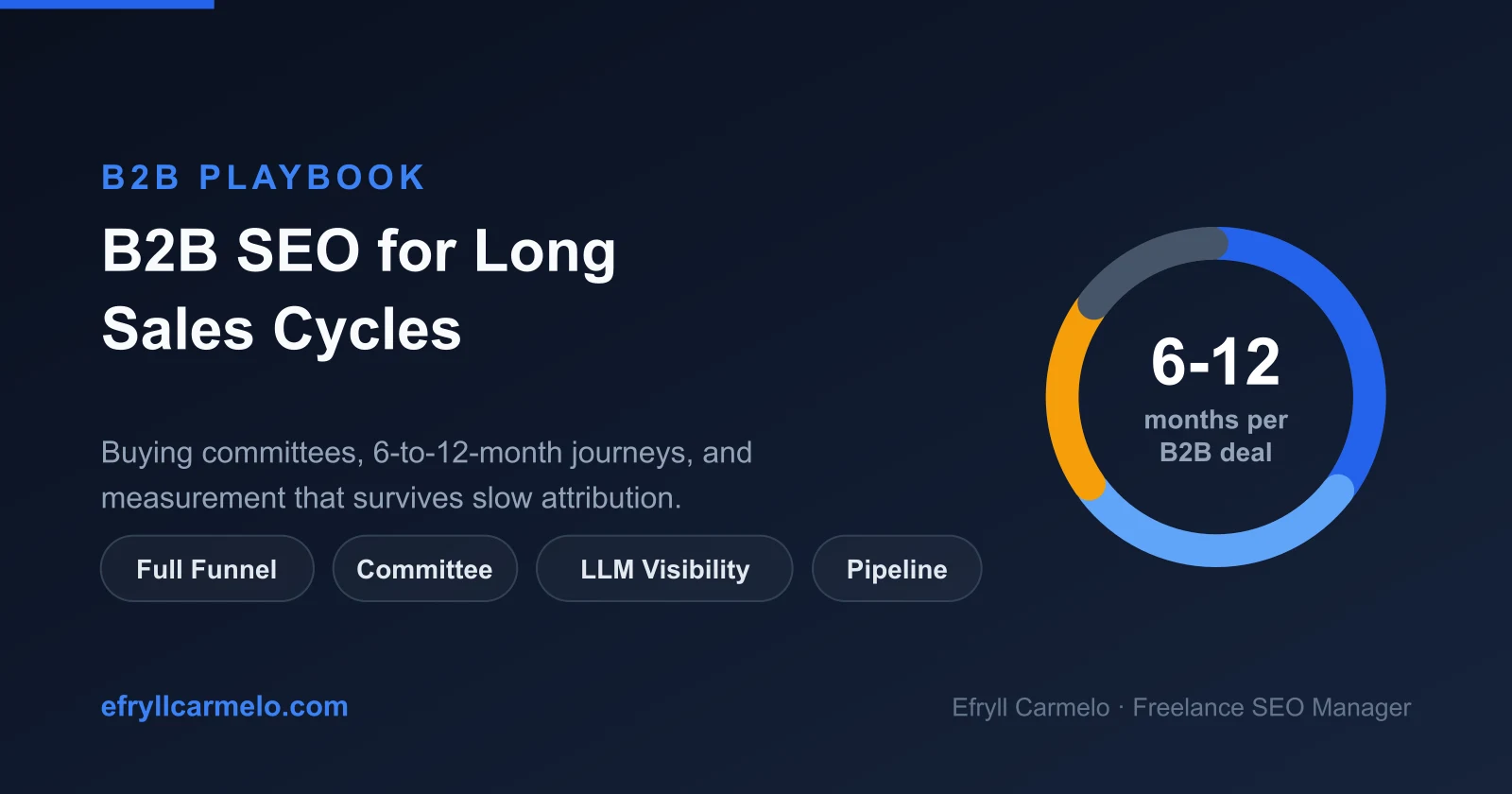
- B2B SEO is a different sport: tiny search volumes, six-figure deal values, five-person buying committees, and 6-to-12-month cycles.
- The playbook: map content to the entire buying journey, write for every committee member, win the comparison and alternatives queries, and get cited by the AI assistants where buyers now build shortlists.
- Measurement must match the cycle: first-touch attribution and CRM integration, because January's visitor closes in September.
- Depth beats volume, which is exactly why this work suits a senior freelancer over a content mill.
I learned B2B SEO the immersive way: embedded at Jumpfactor, a specialist B2B marketing agency, working campaigns for IT services and SaaS companies where a single closed deal justified a year of SEO budget. That experience rewired how I think about search, because almost everything the B2C playbook optimizes for is the wrong target in B2B.
The Physics of B2B Search
Start with the constraint that shapes everything: your buyer researches for months before talking to anyone. Search Engine Land's coverage of B2B buying behavior makes a point I see confirmed in every engagement: most B2B buying decisions are effectively shaped on day one of the research process, long before a sales conversation. By the time a prospect fills your form, they have usually built a shortlist, read comparisons, and half-decided. SEO is how you get into that invisible early conversation. Their older but still accurate piece on SEO for lengthening B2B sales cycles frames the same reality: SEO's job in B2B is filling the nurture pipeline, not closing.
Mapping Content to the Committee and the Journey
The core deliverable of my B2B engagements is a content map with two axes: journey stage and committee member. Every cell answers a real question someone types.
| Stage | What they search | Content that wins | Measured by |
|---|---|---|---|
| Problem-aware | "why does [problem] keep happening" | Diagnostic content, frameworks, benchmarks | Impressions, engaged reads, AI citations |
| Solution-aware | "[category] software", "managed [service]" | Category and service pages with real depth | Rankings, demo-page flow |
| Comparison | "[you] vs [competitor]", "[competitor] alternatives" | Honest comparison pages, alternatives pages | High-intent conversions |
| Validation | "[you] reviews", "[you] pricing", "[you] case studies" | Case studies, pricing transparency, security pages | Assisted conversions, sales feedback |
| Technical evaluator | "[category] integration with [stack]", docs queries | Documentation, integration pages, architecture content | Committee coverage, deal velocity |
Two opinions earned from doing this repeatedly. First, comparison and alternatives pages are the highest-ROI URLs in B2B, and companies avoid them out of squeamishness about naming competitors. Your buyers run those searches whether you participate or not; the only question is whose framing they read. Second, a page targeting 30 searches a month is not a failure. If those 30 searchers are CTOs with budget, that page outearns a 10,000-visit listicle by an order of magnitude.
The 2026 Layer: Your Category Inside the LLMs
The buying committee's research now starts, increasingly, inside ChatGPT and Perplexity: "give me a shortlist of [category] vendors for a mid-market company." If the assistant's answer names your competitors and not you, you were eliminated from a deal you never saw. Search Engine Land's guide to optimizing LLMs for B2B SEO covers the theory; in practice I run the client's category queries through the major assistants monthly, log citations, and work the gap: answer-shaped category content, schema, and presence on the third-party roundups the engines trust. The full method is in my post on handling AI search as a freelance SEO manager, and it is now inseparable from B2B scope.
Measurement That Survives a Nine-Month Attribution Window
B2B SEO dies in reporting meetings when it is judged by B2C metrics. A month with 12 conversions sounds like failure until you learn two were enterprise demos. So my B2B reporting stack does three things: first-touch attribution preserved in the CRM (so September's deal credits January's blog post), pipeline value by landing page rather than raw conversion counts, and leading indicators (rankings, comparison-page engagement, AI citations) that show the machine working during the quiet months. The proof this works: my assisted living client, a classic long-consideration sale involving families and multiple decision makers, saw +233% lead generation and a 75% vacancy reduction once content stopped chasing volume and started covering the actual decision journey.
Why This Suits a Freelancer
B2B SEO's bottleneck is never content volume; it is business understanding. The winning pages get written after conversations with your sales team and subject-matter experts, and that closeness is structurally easier with one senior person embedded in your Slack than through an account-management layer. It is the model my B2B SEO services page describes, with the strategy discipline detailed on my content strategy page, and it is how I have worked since my agency years: as a freelance SEO manager who functions like a fractional head of organic. For scale needs (mass content production, big migrations), agencies and teams have their place, and I have led those setups too; the point is fit, not ideology.
If your sales cycle is measured in months and your SEO is still measured in monthly traffic, those two facts are fighting each other. Book a free consultation and bring your pipeline numbers; I will show you what your buying journey looks like in search data, including the comparison queries you are currently losing.
If you are a B2B company weighing this up, my remote SEO manager page sets out how the working relationship runs day to day, including time zone overlap, reporting rhythm, and how I direct your existing writers and developers.
Frequently Asked Questions
How is B2B SEO different from B2C SEO?
Four structural differences: sales cycles run months instead of minutes, so content must serve a long research journey; purchases involve a buying committee where the end user, the budget holder, and technical evaluators all search differently; search volumes are small but each query can represent six-figure deal value; and success is measured in qualified pipeline rather than traffic. Tactics that look inefficient in B2C, like a page targeting 30 searches a month, are often the highest-ROI pages in B2B.
How long does B2B SEO take to show results?
Expect leading indicators (rankings, impressions, engaged sessions on comparison pages) within 3 to 6 months, and pipeline impact within 6 to 12 months, because the sales cycle itself sits between a first visit and a closed deal. A prospect who finds you through search in January may sign in September. This is why B2B SEO measurement tracks the full journey with first-touch attribution and CRM integration, not just monthly conversion counts.
Does a B2B company need an agency for SEO?
Not necessarily. B2B SEO rewards depth of business understanding more than volume of output: a small number of precisely targeted pages usually beats a high-volume content program. That profile suits a senior freelance SEO manager working closely with your subject-matter experts. Agencies fit when you need large-scale content production or many parallel channels; a senior freelancer fits when you need strategy, precision, and direct access to the person doing the work.
Why does my B2B company need to show up in ChatGPT answers?
Because B2B buyers now start vendor research inside AI assistants, asking for shortlists and comparisons before they ever visit a website. If ChatGPT, Perplexity, and Google AI Overviews consistently name your competitors when describing your category, you are eliminated from deals you never knew existed. Optimizing for LLM visibility, being cited and recommended in AI answers, has become part of the B2B SEO scope in 2026.

Efryll Carmelo
Efryll Carmelo is a Senior SEO Manager and freelance SEO specialist based in Iloilo City, Philippines, with 15+ years of experience in SEO, content strategy, and AI search optimization for clients in the US, Canada, UK, and Australia. He's the sole author of this blog. You can connect with him on LinkedIn.