TL;DR
- I built a hub of ten custom tools that absorb the repetitive layer of SEO work: crawl diffs, data pulls, monitoring, report assembly.
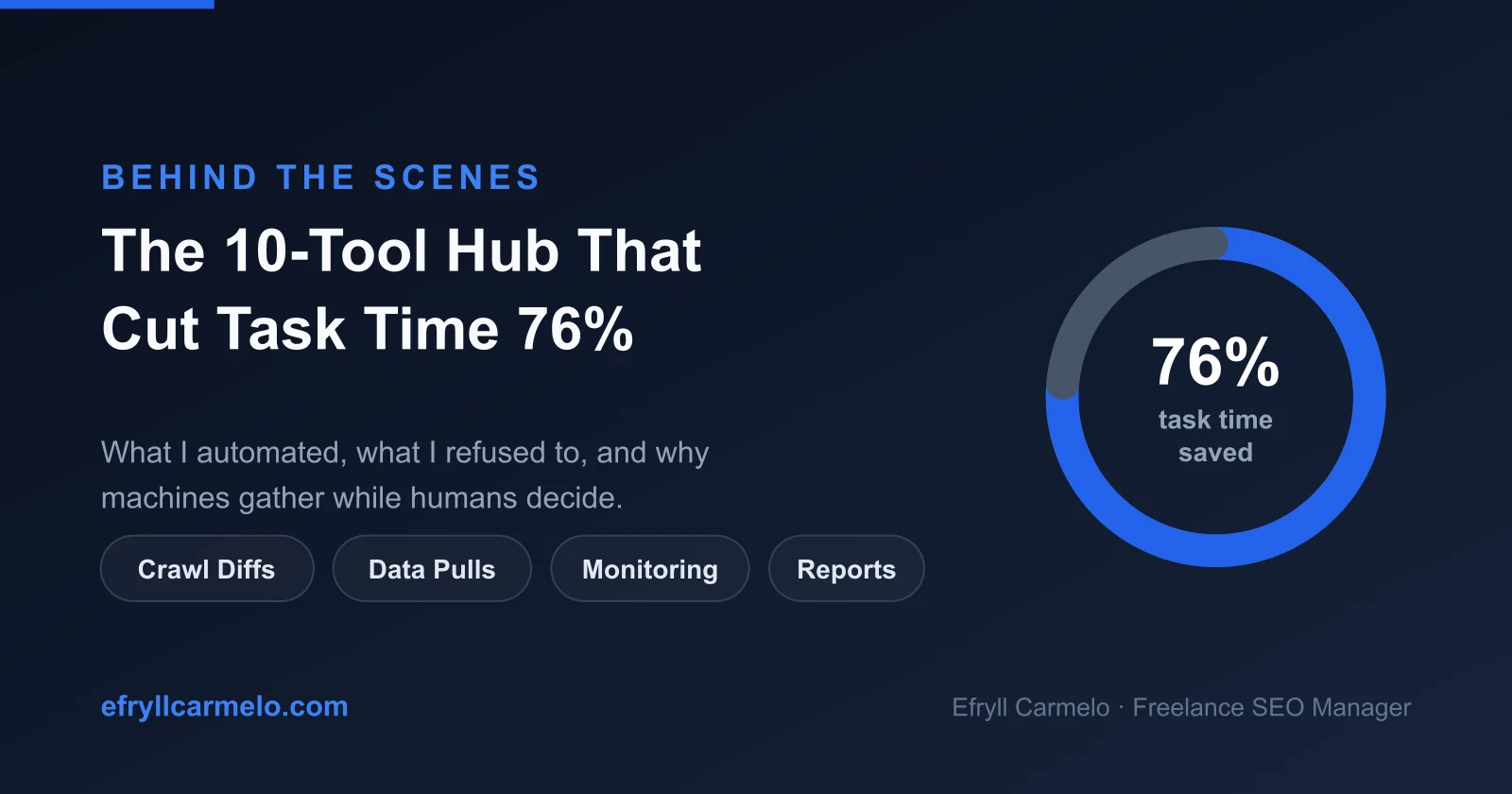
- Measured result: 76% less time on routine tasks, which is the structural reason a solo specialist can deliver what used to need a pod.
- The iron rule: machines gather, humans decide. Nothing a client reads ships without judgment applied.
- For buyers, one interview question falls out of this: ask any provider what they automate and what they refuse to.
Every efficiency in my practice traces back to one irritating realization, sometime around my thousandth crawl export: most of what I did every week was not SEO. It was fetching, formatting, comparing, and pasting, the logistics around the thinking rather than the thinking. So I started building tools to eat the logistics. Ten tools later, the routine layer of my week runs itself, and the measured saving is 76% of task time.
What the Ten Tools Actually Do
| # | Tool | Replaces | Feeds into |
|---|---|---|---|
| 1 | Crawl differ | Manually comparing weekly Screaming Frog exports | Monday triage list |
| 2 | GSC puller | Hand-exporting query and page data per client | Optimization targets, reports |
| 3 | GA4 aggregator | Rebuilding the same explorations monthly | Business-outcome reporting |
| 4 | Rank snapshotter | Screenshot-and-spreadsheet ranking logs | Movement analysis |
| 5 | Technical monitor | Discovering breakage at month-end | Same-day alerts on 404s, noindex, robots changes |
| 6 | SERP feature logger | Eyeballing SERPs for feature changes | AI Overview and feature tracking |
| 7 | Citation checker | Manually querying AI engines and pasting answers | GEO share-of-voice table |
| 8 | Internal link mapper | Crawl spelunking for orphans and link gaps | Architecture fixes |
| 9 | Content scorer | First-pass audits of hundreds of URLs | Keep/improve/prune shortlists |
| 10 | Report assembler | Copy-paste report building | The monthly report skeleton |
Notice what every row has in common: each tool produces an input to a decision, never the decision. Tool 9 shortlists pages that LOOK weak; whether a page lives or dies is judged with human eyes on the actual content, the way I described in my 9-step audit process. Tool 10 assembles the skeleton; the summary a client reads is written fresh every month, per the system in my reporting post.
Where the 76% Comes From
I measured before and after because I bill on outcomes and needed to know where my hours went. Crawl analysis dropped from about two hours per site to fifteen minutes of reviewing flagged diffs. Monthly data assembly went from most of a day to under an hour. Monitoring went from "whenever I remember" to continuous, with alerts. Across the routine layer, the reduction came out at 76%, and the freed hours did not become margin; they became the judgment work clients actually feel: strategy, content quality, and the citation-gap analysis I walked through in my competitor analysis process.
That reinvestment point is the entire game, and it is my main critique of how the industry talks about AI efficiency. Saved hours either deepen each client's service or dilute it across more clients. The tooling is identical; the business model decides whether automation serves the client or just the provider.
The Line I Will Not Cross: What Never Gets Automated
Since I sell AI-era SEO, let me be precise about the boundary. I automate gathering, comparing, monitoring, and assembling. I do not automate strategy, prioritization, interpretation, or anything with a client's name on it. Not from sentimentality: from scar tissue. I watched the industry automate link building in 2011, and I spent the years after cleaning up what the robots built; that story is in my 15-year journey. Today's equivalent temptation is AI-generated content and AI-generated "strategy" at scale, and the industry coverage is honest about where machine output needs human intervention; Search Engine Land's piece on AI-assisted competitor analysis is refreshingly blunt that unreviewed AI classifications will quietly mislead you, and their tour of content audit workflows built in Claude shows the same pattern that works in my hub: AI accelerates the analysis a human then owns.
What This Means If You Are Hiring
Two takeaways for buyers. First, automation is now table stakes: a provider doing everything by hand is charging you human rates for robot work, and it shows up as slow delivery. Second, the interview question that reveals everything: "What do you automate, and what do you refuse to automate?" A good answer names the boring layer for the machines and claims the judgment layer for themselves. A worrying answer either rejects automation entirely or, worse, cannot tell you where the line is. Add it to the list in my 12 hiring questions.
This post closes a 15-article series on what working with a senior freelance SEO manager in the Philippines actually looks like, from the weekly workflow to pricing, hiring, AI search, and the systems underneath. If the series did its job, you now know exactly what you would be buying. The hub, the judgment, and the fifteen years behind both are available the same way everything here started: a free 30-minute consultation, or the long way around via SEO consulting if you want the thinking without the retainer.
How It Was Actually Built
There was no grand plan. The hub accumulated over several years, one irritation at a time, which is the only way I have seen this kind of thing survive contact with real work.
The stack is deliberately unglamorous:
Google Apps Script
The backbone. Free, runs on a schedule, sits natively next to Sheets and the Google APIs, and needs no server to maintain. Most of the data pullers live here.
Google Sheets
The database, unfashionably. It is inspectable, shareable with clients, and when something breaks I can see exactly which cell is wrong. A real database would have been worse for this.
Make
The glue between services that do not talk to each other natively, and the alerting layer that pushes notifications when a monitor trips.
Node.js and Claude Code
For the heavier lifting: crawl parsing, diffing large exports, and anything that needs real processing. AI assistance made building these dramatically faster than it would have been five years ago.
Two principles kept it maintainable. First, every tool does one thing, so when one breaks it breaks alone rather than taking the system down. Second, every tool writes to a Sheet a human can read, so debugging never requires reading logs. Neither is elegant engineering. Both are why it still runs.
What I Tried That Failed
The 76% number gets attention, so it is worth being clear about the attempts that produced nothing, or worse. Four stand out.
- Automated content generation. I built a pipeline that drafted blog posts from briefs. The output was grammatically fine and completely worthless: no first-hand experience, no opinion, nothing a reader could not get elsewhere. In 2026 this is also exactly the material AI answers absorb and nobody cites. I deleted it and have not rebuilt it.
- Automated disavow decisions. A scorer that flagged toxic links and generated a disavow file. It flagged legitimate links from small industry sites as spam, and disavowing good links is a self-inflicted penalty that takes months to undo. Link judgment stayed manual permanently.
- Fully automated client reports. The assembler builds the skeleton, and for a while I let it write the summary too. Clients noticed immediately. The summary is the one part of the report they actually read, and a generated one has no point of view. It is written by hand every month now.
- Real-time rank tracking dashboards. This one failed for a different reason: it worked perfectly and was useless. Daily rank fluctuation is noise, and watching it changes no decisions while consuming attention. I moved it to weekly snapshots and stopped looking between them.
The pattern in the first three is identical. Automation succeeds at gathering and fails at judging. The fourth is a different lesson worth naming separately: a tool can work exactly as designed and still be worth deleting if the information it produces does not change what you do.
The Week, Before and After
Percentages are abstract. The concrete version is what a Monday looks like on a portfolio of clients.
| Task | Before | After | What changed |
|---|---|---|---|
| Monday technical triage across clients | 2 to 3 hours of exporting and comparing crawls | 15 minutes reviewing a pre-built diff | The crawl differ runs overnight; I read conclusions rather than build them |
| Pulling GSC and GA4 data for reporting | Around 45 minutes per client, monthly | Near zero, data is already in the sheet | Scheduled pullers, no manual exports |
| Discovering a technical break | Whenever someone noticed, sometimes weeks | Same day, by alert | This is the change with the largest business impact, and it saves no time at all |
| Checking AI engine citations | Not done, because it was too tedious | Logged monthly, automatically | Automation made a new category of work possible rather than faster |
| Assembling the monthly report | 2 hours of copy and paste | 20 minutes writing the parts that need judgment | Skeleton generated, narrative written by hand |
The two rows worth dwelling on are the ones where the saving is not the point. Same-day breakage alerts do not save time; they prevent damage. And the citation logging replaced nothing, because before the tool existed I simply did not do it. Some of the best returns from automation are not efficiency at all. They are things that were previously too tedious to be worth doing.
Should You Build Your Own?
Usually no, and I say that as someone who did. The honest test is repetition multiplied by consistency.
- Build it if you do the task at least weekly, the steps are identical every time, the inputs come from an API rather than a human, and the output feeds a decision you already know how to make.
- Do not build it if the task needs judgment at any step, happens monthly or less, or changes shape depending on the client. You will spend more time maintaining the tool than doing the work.
- Buy instead if a tool already exists and costs less than a few hours of your time per year. Half the things I built early on are now standard features in Semrush or Ahrefs, and I would not rebuild them today.
The real constraint is maintenance, not construction. Every tool is a small ongoing liability: APIs change, formats shift, something breaks quietly. Ten tools is close to the ceiling of what one person can maintain alongside actual client work, which is why the hub stopped at ten rather than thirty.
Frequently Asked Questions
What SEO tasks can be automated?
The gathering and assembly layer automates well: scheduled crawls and crawl comparisons, rank tracking pulls, GA4 and Search Console data aggregation, report assembly, technical monitoring alerts, SERP snapshot logging, internal link inventories, and first-pass content scoring. What does not automate safely is judgment: deciding priorities, interpreting why numbers moved, strategy, and anything a client reads without human review. The working rule: machines gather, humans decide.
How much time does SEO automation save?
In my measured experience, a purpose-built automation layer cut routine task time by 76 percent across crawl analysis, data pulls, monitoring, and report preparation. The saved hours matter only if they are reinvested in judgment work: strategy, content quality, and client communication. Automation that simply lets a provider serve more clients with the same total attention produces no benefit for any individual client.
Should I hire an SEO who uses AI and automation?
Yes, with one condition: they can explain exactly where automation ends and their judgment begins. Automation is now table stakes for competitive delivery speed, and refusing it means paying human rates for robot work. The red flag is the inverse provider, one who automates the thinking: AI-generated strategies and unreviewed AI content at scale. Ask what is automated, what stays human, and what a client-visible deliverable goes through before it reaches you.
Do I need custom tools for SEO or are commercial tools enough?
Commercial suites like Semrush, Screaming Frog, and SE Ranking cover most needs and are where everyone should start. Custom tooling earns its build cost in the connections between them: joining crawl, analytics, and ranking data into one view, applying your specific priorities and thresholds, and assembling outputs in your reporting format. Custom tools are workflow glue, not replacements for the commercial stack.
What technology is the SEO automation hub built on?
Deliberately unglamorous tooling: Google Apps Script as the backbone because it is free, runs on a schedule, and sits natively beside Sheets and the Google APIs with no server to maintain; Google Sheets as the database because it is inspectable and shareable with clients; Make as the glue between services that do not talk natively and as the alerting layer; and Node.js with AI assistance for heavier work like crawl parsing and diffing large exports. Two principles keep it maintainable: every tool does one thing so failures stay isolated, and every tool writes to a sheet a human can read so debugging never means reading logs.
What SEO tasks should never be automated?
Four attempts failed in my own hub and are worth naming. Automated content generation produced grammatically fine, worthless output with no first-hand experience, exactly the material AI answers absorb and nobody cites. Automated disavow decisions flagged legitimate links from small industry sites as spam, and disavowing good links is a self-inflicted penalty taking months to undo. Fully automated client report summaries were noticed immediately, because the summary is the part clients actually read and a generated one has no point of view. Real-time rank dashboards worked perfectly and were still useless, because daily fluctuation is noise that changes no decisions.
Should I build my own SEO automation tools?
Usually no. The honest test is repetition multiplied by consistency. Build it if you do the task at least weekly, the steps are identical every time, the inputs come from an API rather than a human, and the output feeds a decision you already know how to make. Do not build it if the task needs judgment at any step, happens monthly or less, or changes shape per client. Buy instead if a tool already exists for less than a few hours of your time per year. The real constraint is maintenance rather than construction: every tool is an ongoing liability as APIs and formats change.

Efryll Carmelo
Efryll Carmelo is a Senior SEO Manager and freelance SEO specialist based in Iloilo City, Philippines, with 15+ years of experience in SEO, content strategy, and AI search optimization for clients in the US, Canada, UK, and Australia. He's the sole author of this blog. You can connect with him on LinkedIn.